
Case study · wine merchant
Maison Vauclair
Demo website: no real business is run from it; it shows what the Immersive formula brings to this sector.
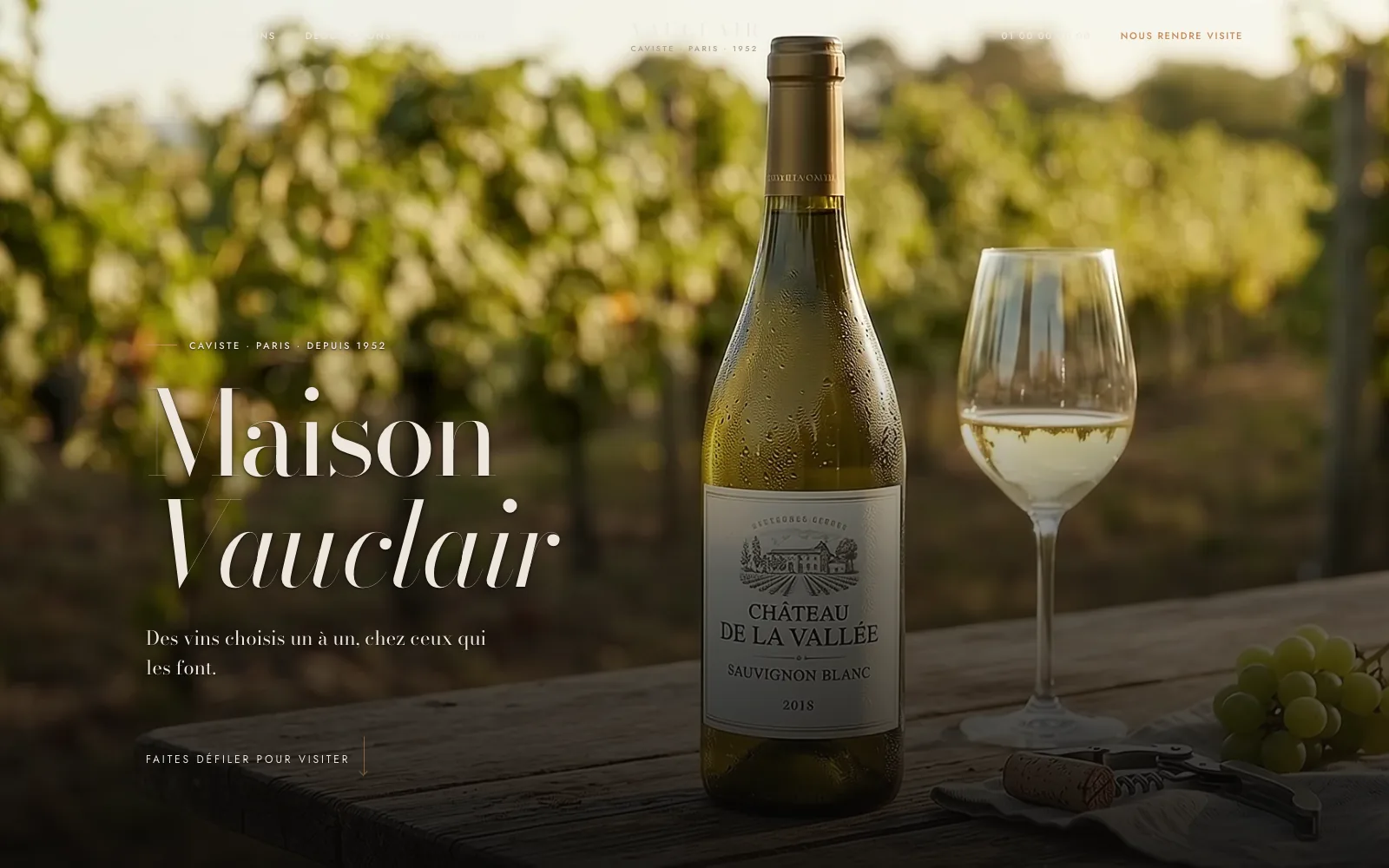
Maison Vauclair is a demo website designed for a fictional wine shop in Paris: no real sale is made on it, but the catalogue, pages and navigation are those of a website delivered to a client. The website itself is in French.
The typical brief for a wine shop
A wine merchant sells advice and a story as much as a bottle: the website has to make people want to walk in, place the house in its terroir, and help a less knowledgeable customer find their way through a sometimes intimidating catalogue. The challenge is to make wine accessible without making it ordinary.
Design choices
The website is organised into five pages (home, the house, the regions, the wines, the visit), each driven by its own scroll videos. The bottle carousel presents the catalogue as a guided tasting rather than a product list, and an interactive globe of wine regions places each appellation geographically — a concrete way to tell the origin of a wine rather than explaining it in text.
The technology behind the demo
The two scroll-driven video sequences (home and visit) use the same frame-by-scroll technique as the other demos, with a memory budget adjusted so that the globe of regions — a separate 3D scene — does not slow down the rest of the site. The five pages share the same technical base, which keeps pace and speed consistent from one page to another.
The virtual tour
The Visit page extends the globe of regions with a more intimate journey: the cellar itself, its shelves, the choices made by the house. The goal is to make people want to visit in person, not to replace the real visit — online sales are not the heart of the site, discovery is what drives it.
Which businesses this approach suits
This direction suits shops where origin, craft or terroir are part of the product sold: wine shops, estates, delicatessens, craft houses. For high-volume sales where price matters more than the story, a classic e-commerce website remains more suitable.
Beyond the demo
The demo stages a wine shop, but the same logic — telling an origin, placing a terroir, guiding rather than listing — carries over to other specialist shops: delicatessens, coffee roasters, craft houses, adapting the content to the real trade rather than reusing the same template.
Is a globe of regions essential?
No: it makes sense for a shop whose catalogue covers several regions or countries, where showing the origin really helps the customer choose. For a shop specialising in a single region, a simple map or well-written text is more than enough.
Can you sell online from this kind of website?
The demo focuses on discovery rather than online sales, but nothing prevents adding an ordering or click-and-collect module if the business needs it — the scope is defined with the client before we start, not afterwards.
Does the globe of regions work on mobile?
Yes, in an adapted version: the 3D scene can still be handled with a finger, with framing specifically designed for a phone screen rather than a simple reduction of the desktop version, in keeping with the care given to the other pages of the site.