
Case study · car rental
Driveo
Demo website: no real business is run from it; it shows what the Immersive formula brings to this sector.
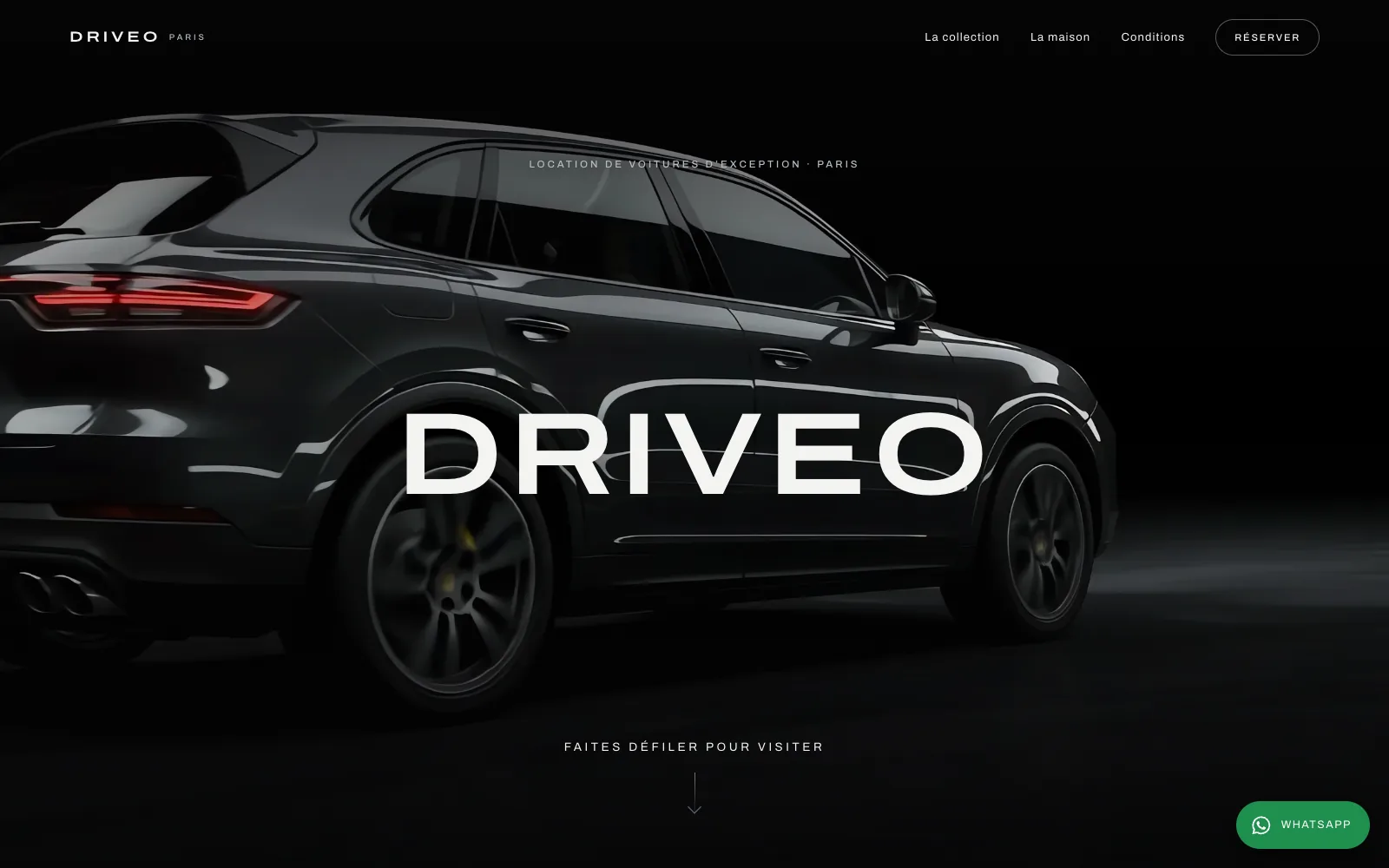
Driveo is a demo website designed for a fictional exceptional car rental agency: no real booking is processed on it, but the car collection, scenes and navigation are those of a website delivered to a client. The website itself is in French.
The typical brief for a high-end rental agency
For this sector, the website first has to make people dream — showing the car from its best angle, in a setting that justifies the price — before giving access to a simple booking, often by the month rather than by the day. Trust depends heavily on visual quality: a generic visual or a catalogue photo immediately devalues the offer.
Design choices
Each car in the collection of 10 has its own scroll-driven 3D video scene: the car turns, and the details (wheels, interior, lines) reveal themselves as you scroll, rather than in a simple gallery of static photos. Monthly rental is highlighted as a short journey, designed for a customer who is already convinced and wants to move fast.
The technology behind the demo
The video scenes are broken down into optimised image sequences, loaded progressively as each section approaches so as not to slow down the initial display. The mobile version uses the same scenes full-screen, with framing specifically reworked rather than a simple resize of the desktop version.
The booking journey
From a car's page, monthly booking takes a few fields — dates, car, contact details — without asking the visitor again for what they have already seen on the page. The point is not to break the effect of the staging with a long form or a redirect to an external tool with a different atmosphere.
Which businesses this approach suits
This treatment suits goods or services where the object itself is the main selling point: cars, exceptional real estate, premium equipment. For a utility fleet or professional use, a simple, fast comparison tool is often more effective than staging.
Beyond the demo
The demo stages a collection of cars, but the same logic — one scene per product, a short booking journey — applies to other things rented or booked individually: boats, prestige goods, event equipment, adapting the staging to the real object rather than reusing the same template.
Is a 3D scene per car necessary?
For a collection of a few exceptional cars, yes: each scene becomes a selling point in its own right. For a larger or more utilitarian fleet, a simpler system of car pages with photos and short videos is more relevant and quicker to maintain over time.
Can the website connect to an existing availability calendar?
Yes: the booking journey is designed to work with a booking tool or calendar the agency already uses, rather than imposing an additional closed system to manage twice.
How long does it take to launch a website like this?
The timeline depends mostly on the number of cars to stage and when the source visuals are available: the larger the collection, the longer it takes to produce the scenes. Scope and timeline are always agreed before we start, not estimated afterwards.