
Case study · restaurant
Carmin Restaurant
Demo website: no real business is run from it; it shows what the Immersive formula brings to this sector.
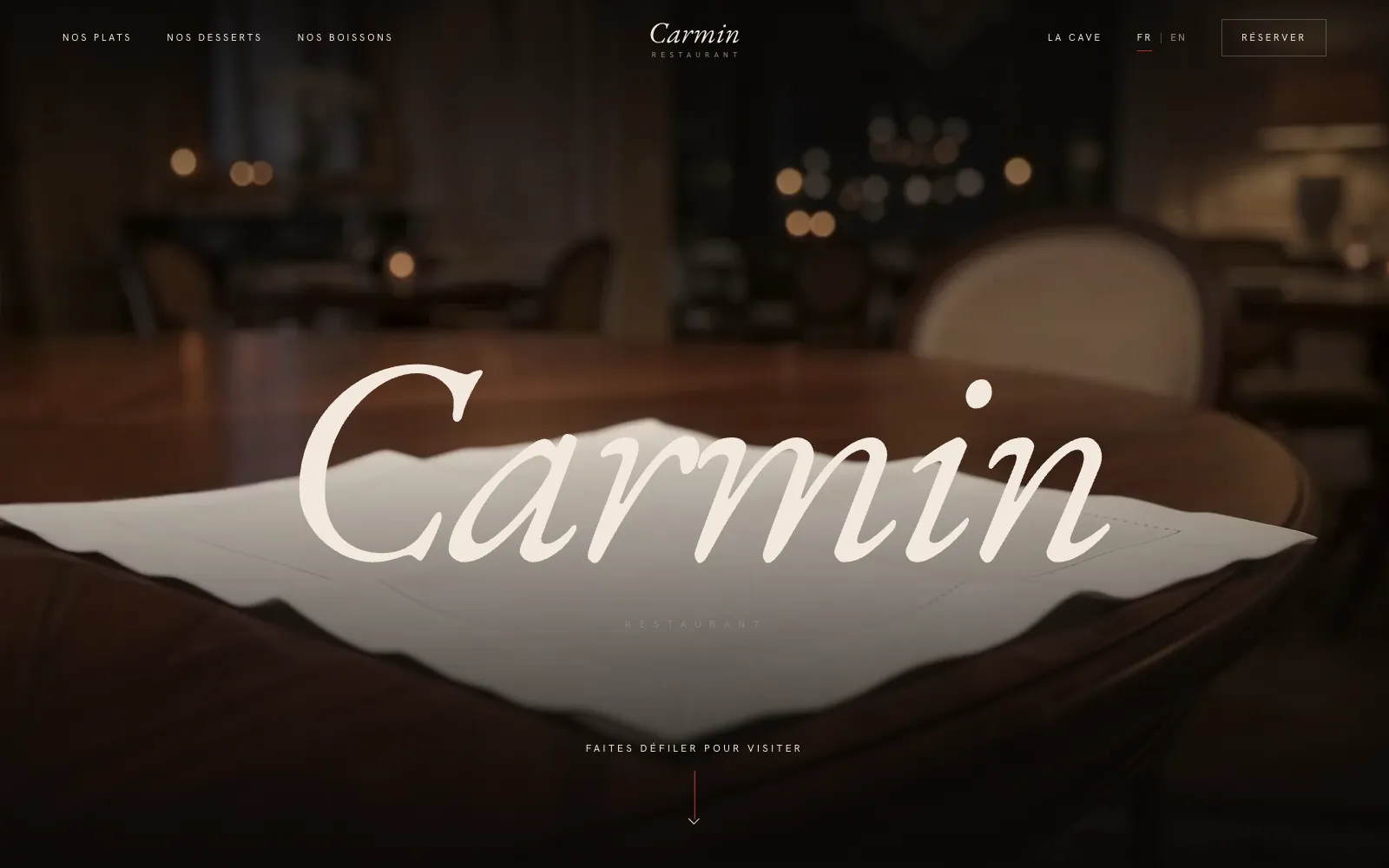
Carmin Restaurant is a demo website designed to show what the Immersive formula brings to a fine-dining restaurant: no real booking is taken on it, but the navigation, animations and pages are those of a website delivered to a client. The website itself is in French.
The typical brief for a fine-dining restaurant
For this kind of establishment, a website has to do two things at once: immediately convey the standard of the house — setting, cooking, service — and give quick access to practical information (menu, opening hours, booking). Visitors often arrive from a search engine or a recommendation, with a precise intention: book a table or get an idea before calling.
Design choices
The home page opens on the dining room filmed as a page background, and a table that sets itself in 3D as you scroll — cutlery, glasses, lighting — before giving way to the menu. The carousel of signature dishes works as an orbit: each dish turns slowly, showcased as if on a table. The Dishes, Desserts, Wine and Drinks pages extend this art direction with their own background video, so that each world (cooking, pastry, cellar) has its own atmosphere rather than a plain text menu.
The technology behind the demo
Everything relies on image sequences (WebP) played frame by frame at the pace of scrolling, rather than a classic video: this makes it possible to synchronise the animation precisely with the visitor's gesture, including on mobile. The dishes carousel is written in plain JavaScript, without a heavy 3D library, to stay fast. Each page has its own mobile version, designed full-screen rather than simply resized from the desktop site.
The booking journey
Booking is deliberately simple: date, time, number of guests, and a clear confirmation. The goal is not to add a complex system, but to give a visible entry point from the moment the page opens, so that a visitor won over by the staging does not have to look for a phone number to take action.
Which businesses this approach suits
This direction suits restaurants, wine merchants or houses where the setting and staging are part of the experience being sold — not just the menu. For a more utilitarian business (fast food, takeaway), a more classic website, fast and focused on ordering, makes more sense.
Beyond the demo
The demo is deliberately limited to the world of a fine-dining restaurant: the same choices (opening scene, carousel, dedicated pages per world) carry over to other houses where the setting matters as much as the product, adapting the staging to the client’s real trade rather than reusing an identical template.
How many pages for a website like this?
Carmin Restaurant has five pages (home, dishes, desserts, wine, drinks): a number suited to a menu that deserves to be detailed by category. For a restaurant with a shorter menu, a single well-built page can be enough — the number of pages is decided based on the real content, never by default.
Does a restaurant necessarily need 3D?
No. 3D and scroll-driven scenes are a relevant choice when the setting is part of the experience being sold, not an obligation. A neighbourhood restaurant with regular customers can do very well with a simpler, faster website focused on opening hours and the menu.